
Real-Time Routing: AI Algorithms in Action
Michael Bar
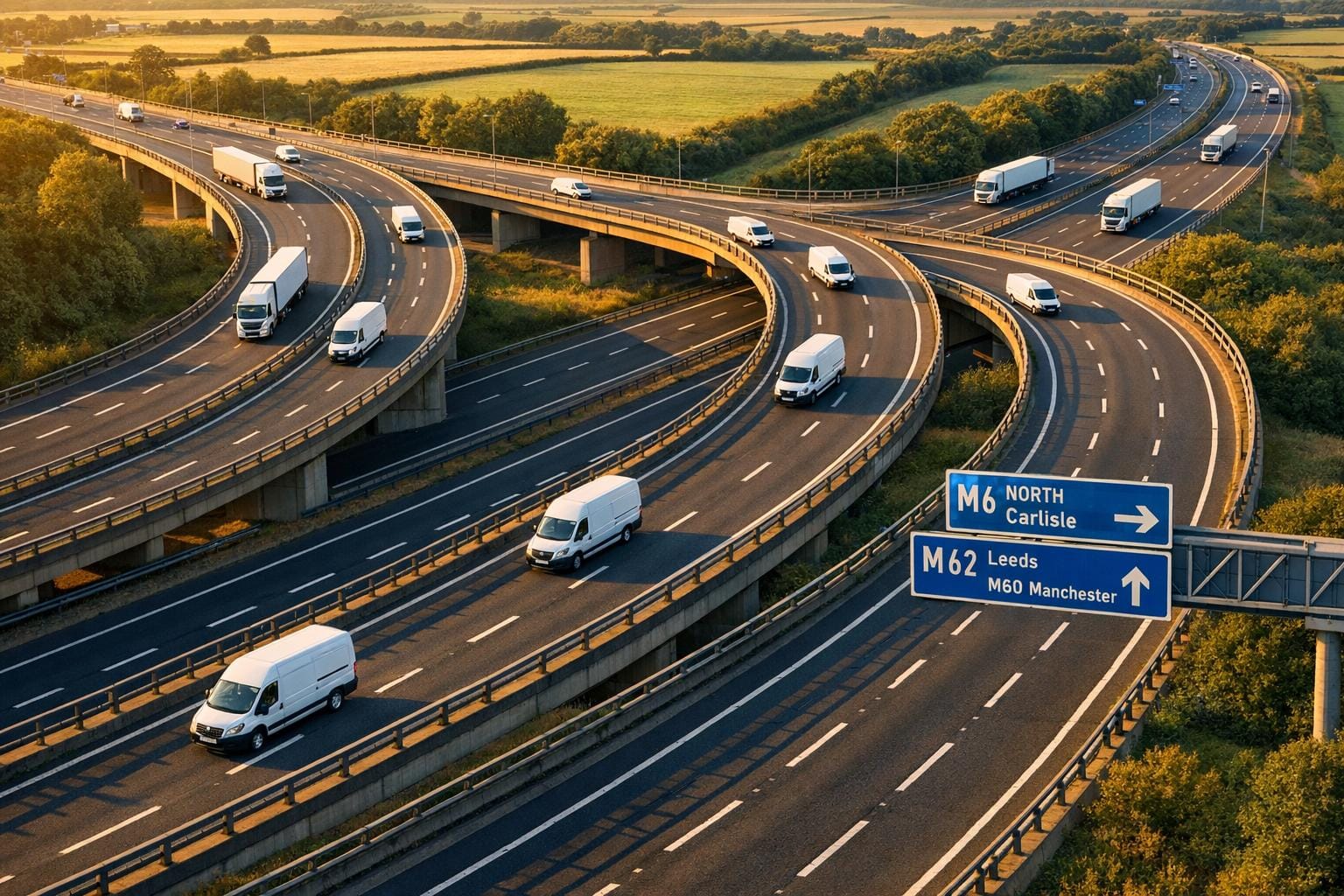
AI-driven real-time routing is transforming logistics in the UK by addressing unpredictable road conditions, rising fuel costs, and strict delivery regulations. Unlike static planning, which relies on fixed schedules and historical data, real-time systems use live inputs like GPS, traffic updates, and weather data to adjust routes instantly. This approach improves delivery efficiency, reduces costs, and ensures on-time performance.
Key takeaways:
- Static Planning: Works for fixed, predictable routes but struggles with unexpected changes like traffic or road closures.
- AI Routing: Uses live data to optimise routes in real time, improving efficiency by up to 30% and boosting delivery accuracy.
- Hybrid Approach: Combines static planning for routine tasks with AI systems for dynamic deliveries, meeting growing demand for same-day delivery.
In the UK, companies like SIG Distribution and DHL have reported significant gains, such as a 25% increase in delivery capacity and 15% better on-time performance. Tools like GRS Fleet Telematics make these systems accessible for businesses of all sizes, starting at £7.99 per month. The shift to real-time routing is reshaping logistics, ensuring faster, more reliable deliveries while cutting costs.
How AI Predicts Traffic & Optimizes Delivery Routes | Future of Smart Logistics 🚚
1. AI-Driven Real-Time Routing
AI-driven routing takes logistics planning to a whole new level by turning unpredictable situations into chances for greater efficiency. Unlike static plans, these systems use live data - like traffic updates, weather forecasts, road conditions, delivery windows, vehicle capacity, and driver availability - to calculate the best routes in real-time. For example, during peak demand events like Black Friday, a retail platform can combine historical sales data with live GPS updates to adjust delivery routes on the fly.
Data Inputs
The real power of AI routing lies in its ability to handle a wide range of data sources. These systems pull in live traffic updates to avoid congestion, adapt routes based on weather changes, and consider vehicle capacity and availability alongside historical performance metrics. They’re also designed to meet specific delivery needs, factoring in customer service windows and driver schedules. For instance, in healthcare logistics, an AI system can quickly reroute vaccine deliveries during unexpected road closures, ensuring they arrive on time and under the required temperature conditions.
Flexibility
AI routing systems shine when things don’t go as planned. If there’s a breakdown, traffic jam, or road closure, the system automatically adjusts routes in real-time. DHL's Resilience360 platform is a great example - it predicts arrival times and shipment destinations with 90–95% accuracy and can divert shipments away from high-risk areas while notifying customers about delays. This kind of flexibility is especially crucial during crises, where finding alternative routes quickly and prioritising emergency deliveries can make all the difference. By reacting instantly to changing conditions, these systems ensure smoother operations even in challenging scenarios.
Optimisation Scope
AI algorithms juggle multiple factors at once, such as delivery urgency, vehicle type and capacity, geographic proximity, and priority orders, to create the most efficient routes. Some systems even go a step further with multi-modal optimisation, balancing air, ground, and sea logistics dynamically. For example, FarEye’s optimisation tools have managed to cut delivery routes by 40%, boosting both productivity and fuel efficiency. They also reduce manual sorting times by over 70% by automatically directing packages based on destination, urgency, and available transport. This ability to handle multiple objectives leads to tangible operational improvements.
Outcomes
In the UK, logistics companies have reported cutting fleet mileage and fuel consumption by 10–30%, while delivery firms have reduced average route times by up to 20%. The Descartes Report highlights that AI tools can reduce planning time by 75% and increase daily delivery capacity by 12%. These improvements go beyond just operations - customers benefit from more accurate ETAs, fewer delays, and better vehicle use. Together, these advantages result in faster deliveries, smarter resource use, and lower costs across sectors like field services, freight, and last-mile delivery. In the UK, integrating real-time routing with van tracking solutions like GRS Fleet Telematics takes efficiency even further by combining route optimisation with advanced vehicle security and live data insights.
2. Static and Rule-Based Planning
Static planning sticks to predetermined routes, relying heavily on historical data and predictable patterns. Unlike AI systems that adjust in real time, this traditional method is built for stability, making it ideal for tasks like weekly supermarket restocking or regular business-to-business deliveries where schedules and volumes rarely change. Routes are planned in advance, and drivers follow these fixed paths unless there's a major operational shift.
Data Inputs
This approach depends on historical delivery records, fixed customer time windows, and predictable order volumes. However, it lacks the ability to incorporate live data like traffic conditions, weather updates, or driver availability. As a result, while it performs well in steady environments, it struggles to handle unexpected challenges such as road closures or sudden spikes in demand.
Flexibility
The rigidity of static planning becomes evident when conditions change. For instance, if a driver encounters a roadblock or heavy traffic, they must figure out an alternative route themselves, as the system doesn’t provide live updates or rerouting options. While this predictability can be beneficial in stable settings, it’s a clear drawback in dynamic scenarios where adaptability is crucial. Unlike AI-driven systems, static planning assumes that tomorrow will look just like today.
Optimisation Scope
Static planning thrives in environments with minimal variability. It’s well-suited for tasks like recurring deliveries - think of milk runs - where conditions remain constant. However, it cannot account for real-time factors like congestion, weather disruptions, or sudden demand surges. In today’s fast-paced logistics world, this lack of adaptability often leaves static methods lagging behind modern customer expectations and operational needs.
Outcomes
Static planning offers predictability and allows drivers to develop local expertise by sticking to familiar routes. However, it falls short when conditions change. Drivers don’t receive real-time ETAs, and delays aren’t automatically rescheduled. This highlights the growing need for agility in UK logistics, where AI-powered dynamic routing is increasingly taking centre stage. While static planning provides consistency, its inability to adjust quickly underscores why the industry is moving towards more flexible, real-time solutions.
Strengths and Weaknesses of Each Approach
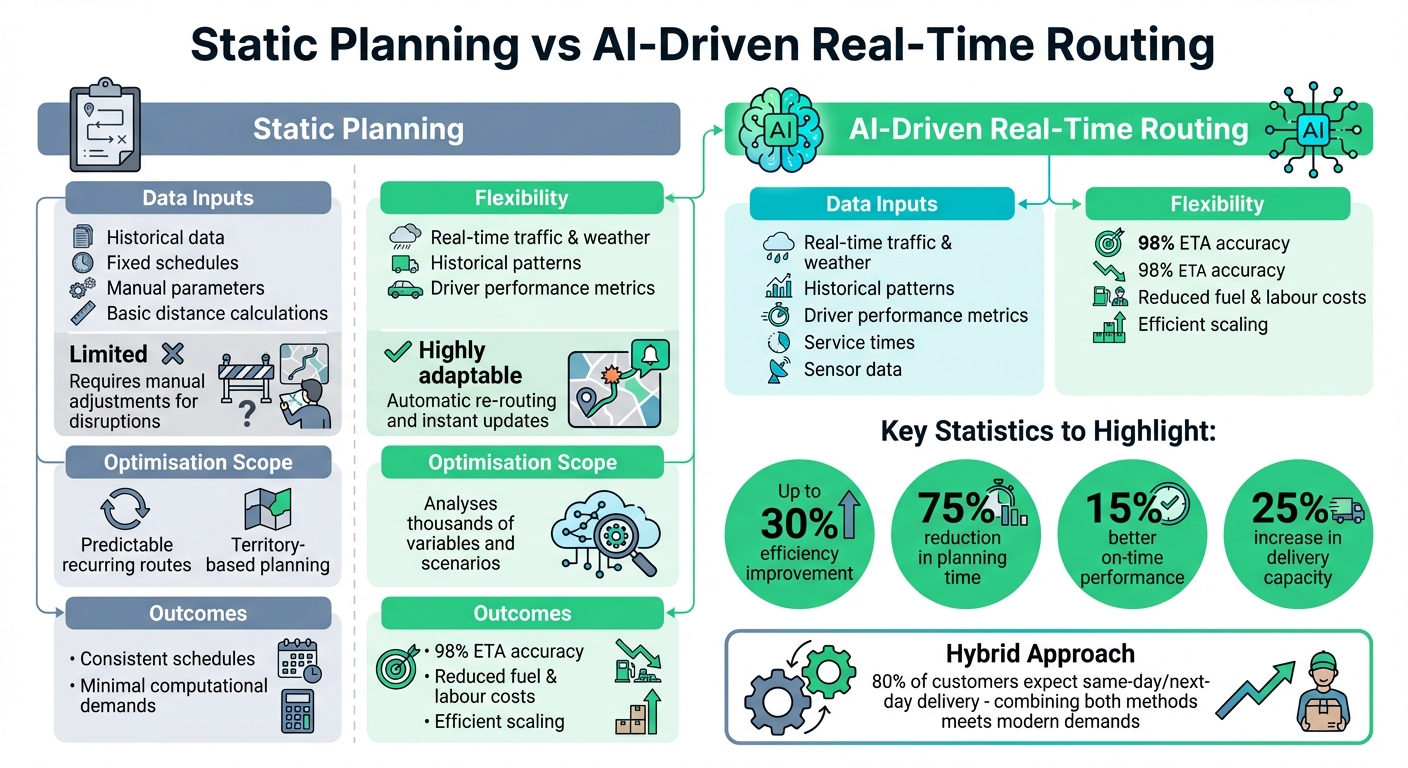
Static Planning vs AI-Driven Real-Time Routing Comparison
The table below highlights how static planning compares to AI-driven real-time routing across several key dimensions.
| Feature | Static Planning | AI-Driven Real-Time Routing |
|---|---|---|
| Data Inputs | Relies on historical data, fixed schedules, manual parameters, and basic distance calculations. | Utilises real-time traffic and weather updates, historical patterns, van tracker systems and driver performance metrics, detailed service times, and sensor data. |
| Flexibility | Limited; requires manual adjustments to handle network changes or unexpected disruptions. | Highly adaptable; supports automatic re-routing and instant updates for last-minute changes. |
| Optimisation Scope | Focuses on predictable, recurring routes and territory-based planning. | Analyses thousands of variables and potential scenarios to find optimal solutions. |
| Outcomes | Provides consistent schedules with minimal computational demands. | Achieves up to 98% ETA accuracy, reduces fuel and labour costs, and scales efficiently. |
This comparison highlights the trade-offs between simplicity and adaptability, offering a clear view of how each method serves different needs.
Static planning works best in stable, predictable conditions. It’s less resource-intensive and provides drivers with familiar, consistent routes. However, it falters when faced with unexpected challenges like road closures, sudden demand surges, or extreme weather. As Komal Puri, AVP Marketing at FarEye, explains:
"Static routing provides stability for predictable operations, whereas dynamic routing offers crucial adaptability."
On the other hand, AI-driven routing thrives in dynamic environments. By analysing real-time traffic, weather, and even driver performance, it can adapt in the moment, delivering 98% ETA accuracy. While this approach demands more computational power and bandwidth, the benefits often outweigh the costs. For example, traffic congestion costs the trucking industry approximately £58 billion annually, or £5,000 per truck. The savings on fuel and operational efficiency often justify the investment.
In the UK, many logistics companies now use a hybrid approach - combining static routes for routine tasks with AI-driven systems for urgent, variable deliveries. This balance is increasingly essential as 80% of customers expect same-day or next-day delivery, a demand static planning struggles to meet consistently.
These insights underscore the growing importance of data-driven, real-time solutions in modern logistics. By blending the strengths of both methods, companies can better navigate the challenges of today’s fast-paced delivery expectations.
How AI Routing Works in UK Logistics
In the fast-paced world of UK logistics, AI routing systems stand out by handling massive amounts of real-time data. These systems gather information from sources like GPS trackers, traffic APIs, weather updates, and historical delivery records. Using machine learning algorithms, they continuously adjust routes to minimise delays and improve efficiency.
Take SIG Distribution, a UK builders' merchant, as an example. They’ve adopted an AI-powered routing system that processes live traffic conditions, weather data, and delivery timeframes. The result? A 25% boost in delivery capacity, lower fuel expenses, and a 15% increase in on-time-in-full (OTIF) deliveries. Other logistics operators across the UK have also seen noticeable reductions in route times by integrating live data into their operations.
GRS Fleet Telematics takes this a step further by combining real-time GPS tracking with dual-tracker technology, starting at £7.99 per month. Each vehicle is equipped with two independent trackers to ensure uninterrupted data flow - even if one tracker fails. This redundancy not only ensures a 91% recovery rate for stolen vans but also feeds accurate location data into AI systems to optimise routes. Fleet managers can monitor vehicles in real time, receiving instant alerts about disruptions like closures on the M25 or unexpected traffic. This allows dispatchers to reroute drivers immediately, avoiding major delays.
Research shows that businesses using AI routing systems see marked improvements in their operations. For UK SMEs, which often operate on tight budgets, solutions like GRS Fleet Telematics offer a cost-effective way to tackle the country’s unpredictable road conditions. Whether it’s navigating London’s congestion charge zones or dealing with icy rural roads in winter, these systems prove adaptable and effective.
Conclusion
AI routing reacts in real-time to live data, making it ideal for dynamic and unpredictable situations. On the other hand, static planning works best for fixed, routine deliveries, like established B2B routes or regular stock replenishments. However, static methods often fall short when unexpected changes, such as traffic or weather disruptions, occur. AI routing shines in these scenarios, using live traffic updates, weather conditions, and driver availability to adjust routes instantly. This highlights how static planning supports routine operations, while AI routing becomes indispensable when flexibility is required.
For UK logistics, especially with challenges like M25 congestion or sudden weather changes, AI routing delivers clear advantages. It can cut planning time by 75% and improve on-time deliveries by 15%. With nearly 80% of consumers now expecting same-day delivery, having the ability to adapt quickly to shifting conditions has become a necessity.
Hybrid models are proving to be an effective solution, combining static planning for morning collections with AI routing for urgent, last-minute orders. This approach ensures smooth handling of both routine tasks and unexpected demands. Additionally, fleets operating on tight budgets can benefit significantly when AI routing is paired with reliable tracking systems. For example, tools like GRS Fleet Telematics provide real-time data feeds and start at just £7.99 per month, helping to keep routes optimised even in rapidly changing conditions.
FAQs
What data does AI routing need to work well?
AI routing systems depend on a variety of real-time data to operate efficiently. They draw from live traffic updates, weather conditions, and vehicle metrics like engine health and fuel levels. Other factors, such as road restrictions, past delivery records, and driver habits, also play a crucial role in refining route planning. By combining these data sources, AI can adjust routes dynamically, helping to minimise delays, lower costs, and boost customer satisfaction.
When should I use static routes vs real-time routing?
Static routes work well when you need consistent and predictable delivery patterns, especially in situations where conditions remain stable. On the other hand, real-time routing shines in more dynamic scenarios. Whether it’s unexpected traffic, sudden weather disruptions, or last-minute changes to schedules, real-time routing allows you to adapt on the fly. This approach not only boosts efficiency but also enhances customer satisfaction by enabling quick, data-driven decisions in challenging environments.
How hard is it to add real-time routing to my fleet?
Adding real-time routing to your fleet has become more straightforward thanks to advancements in AI algorithms and telematics systems. These modern tools combine live data - such as traffic conditions, weather updates, and vehicle performance metrics - to enable dynamic route adjustments on the go. While there is some initial setup involved, the benefits are clear: improved efficiency, lower fuel costs, and enhanced delivery reliability. Most fleets see returns on their investment within 8–12 months. Partnering with a dependable technology provider can make the integration process seamless.